Mastering the accessibility options in World of Warcraft is an underutilized progression path that directly enhances your cognitive processing speed. Every player has different visual and auditory thresholds; the default interface is a “generalist” solution that may not be optimal for your specific needs. For players aiming to reduce eye strain and improve mechanical recognition, developing an “Accessibility-First” routine forms a reliable framework for mastery. It is about tailoring the game’s language to match your own internal hardware.
This guide examines how to approach interface adjustments efficiently, focusing on the logic of “Color Contrast,” the mechanics of “Text Legibility,” and the strategic use of built-in alerts to ensure you never miss a critical combat event.
The Logic of Cognitive Ease
Accessibility is not just for those with permanent impairments; it is a tool for “Cognitive Ease.” When information is presented in a way that is easy for your brain to consume, you free up mental energy for high-level strategy. A successful accessibility routine uses deterministic changes to “Amplify” important data. If you struggle to see the mouse cursor in the chaos of forty nameplates, using a high-contrast cursor “Override” is a tactical upgrade. You stop “searching” for your tools and start “using” them immediately.
Core Tactics: Colorblind Modes and Font Scaling
To improve your recognition speed without using complex addons, you must utilize these specific built-in habits:
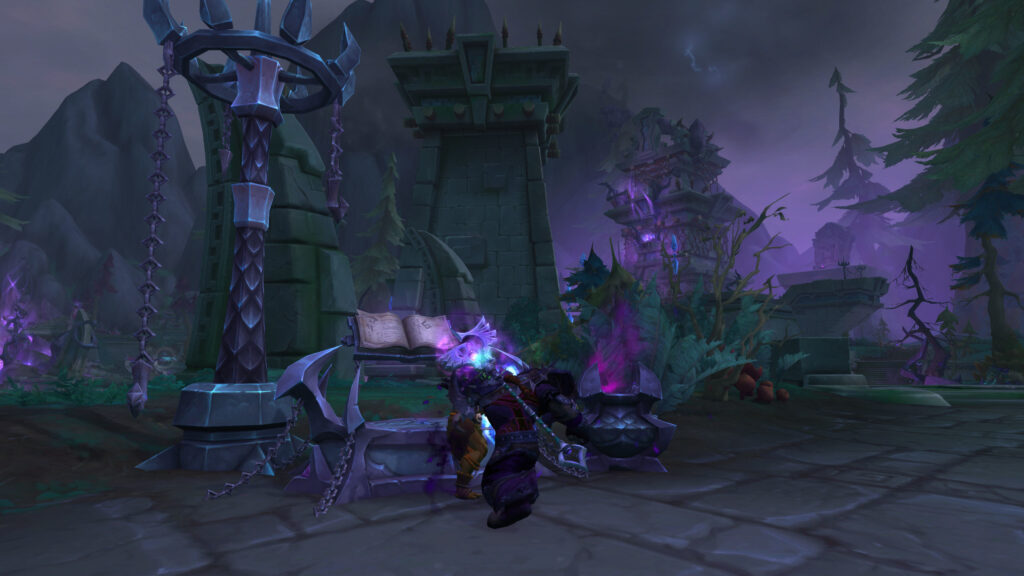
- Enhanced Colorblind Modes: Even if you aren’t colorblind, using modes like “Protanopia” or “Deuteranopia” can increase the contrast between red ground effects and green terrain. This “Chromatic Separation” makes lethal zones pop with more intensity, providing a deterministic advantage in outdoor or jungle-themed dungeons where colors often blend.
- Font and UI Scaling: Scale your UI to a size where you can read names and timers without “leaning in.” If you have to squint to see your Haste percentage, your UI is a liability. Use high-legibility, bold fonts for your scrolling combat text to ensure that a “Dodge” or “Miss” notification is processed in milliseconds.
- Photosensitivity and Screen Effects: Disable “Full Screen Glow” and “Death Effect.” These atmospheric filters reduce visual clarity and can cause eye fatigue during long sessions. A veteran raider prefers a “Raw” image that provides the most accurate representation of the battlefield.
Managing “Click-Accuracy” with Cursor Interaction
The greatest hurdle for many players is mouse-targeting. Under stress, it is easy to lose track of where your “Hand” is on the screen. Accessibility tweaks provide a deterministic fix: use the “Cursor Size” setting or an addon like “CursorTrail” to make your pointer a large, glowing beacon. This ensures that your “Target-to-Click” latency is as low as possible. By reducing the time it takes to find your mouse, you improve your ability to land interrupts and select priority targets in a messy pack. This small adjustment is often the difference between a timed key and a wipe.
Establishing the “Comfort Audit”

The final phase of accessibility mastery is the “Comfort Audit.” After an hour of raiding, evaluate your body: are your eyes tired? Is your neck strained? If so, your accessibility settings are not working. Adjust your gamma, brightness, and font sizes until the game feels “effortless” to look at. Integrating these personal adjustments into your routine ensures that you can maintain peak performance for the entire duration of a raid night. You stop being a victim of the game’s default aesthetics and start being the architect of your own focus. Accurate vision, accurate victory.
Conclusion: Victory Through Personalization
Accessibility tweaks reward the self-aware and the meticulous player. By customizing your visual and auditory interface, you nullify the distractions of “standard” settings. Integrating these accessibility habits into your routine ensures that you receive information at the highest possible speed, providing a stable path to high-level mastery through superior personal-interface design.